In Middle-earth, no two battles are fought on the same ground. A shield wall of Iron Hills Dwarves may feel invincible in a grinding slugfest, yet that same wall of steel can feel agonisingly slow when the objective is scattered across the board.
Siege Ladder and Tabletop Admiral have now gathered a total of 16,000 games of data, and so, I wanted to deep-dive into a study of the armies against each of the 24 x scenarios available in MESBG to see if there are any clear patterns around which armies suit particular scenarios.
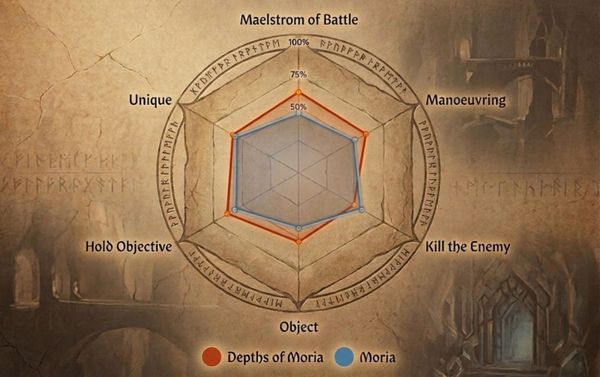
The result of this is something I've called the Shape of War, grouping the scenarios by pool, and analysing the win % of each army against the pools, enabling me to visualise the complexity of the 24 scenarios into a single, visual web, known as a Spider or Radar Chart.
A comparison of two Hobbit-era Elven armies. The more specialist army Rangers of Mirkwood vs the more general purpose Halls of Thranduil
Structuring the Web #
With 107 army lists available and 24 scenarios, to get a sense of clear strengths and weaknesses, we'd just need too many games worth of data in order to get anything meaningful. However, if we instead use the matching pools, then it reduces the required games by 75% in order to get an equivalent statistical significance.
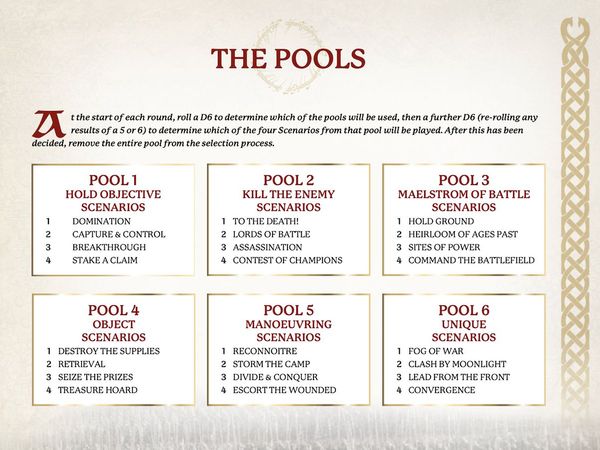
Whilst ideally we would have more data, with the 500 games so far recorded on Siege Ladder and the 15,800 games on Tabletop Admiral, just over 16,000 games is a good place to start.
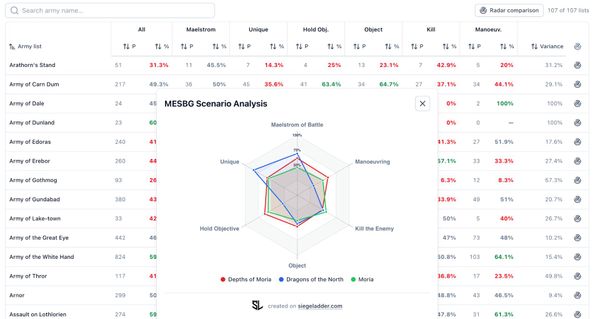
For Siege Ladder, I had all the data available to me in my database, and then I've merged this with a snapshot of the data available on TTA (thanks to Andrew who gave me permission for this). Once merged, I categorise this data into pools and plot this onto a radar chart.
I've made this data all available on Siege Ladder too, so you can have a play around with it here.
Strengths & Weaknesses #
The Best Starting Armies #
Something I see a lot on social platforms for MESBG are new players asking - "what's the best army to start with?"
Thinking about what makes a good starting army, I actually thought this data could do a good job and assisting here. New players ideally want to start with something more generalised, and simple to play, so what are the most well rounded armies in terms of performance? For this we can look at the "Variance", which is the difference between the lowest and highest win percentages across the six pools.
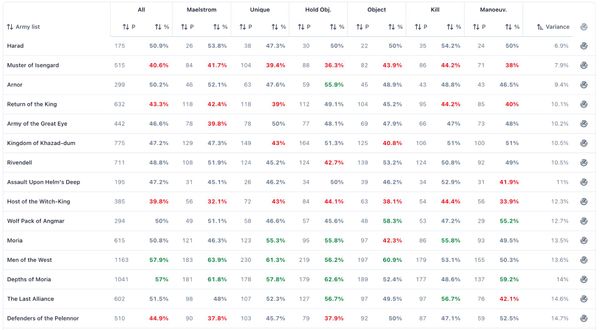
Some of this data should be taken with a pinch of salt, an important column to account for this the number of games played in total for each army. The lower this number, the less accurate the numbers are considered to be.
Despite this, it was still certainly a surprise to see Harad as the army with the lowest variance, with a 50.9% win rate across the board, and tiny 6.9% variance. Whilst they have only got 175 games recorded against them, it's certainly not an army I expected to see here.
Both the Muster of Isengard and Return of the King do standout here though, though they also both have relatively low win rates (40-43%), so may be an uphill fight for most outings, especially for beginners.
Ideal options here actually look to be Rivendell, the general purpose Army of the Great Eye or even, surprisingly, the Kingdom of Khazad Dum.
Specialist Armies #
At the opposite end of the spectrum, we can look at the armies with the largest variance. In this case, I excluded any armies that have less than 180 games recorded, just to ensure some level of statistical significance. With that, the following armies stood out, with some surprises:
Comparing the profiles with the most variance in their performances across the pools. Click items in the key to toggle them on/off.
- Wolves of Isengard (Object: 72%; Unique: 21.9% Variance: 50.1%)
- Breaking of the Fellowship (Kill the Enemy: 72.4%; Manoeuvring: 26%; Variance: 46.4%)
- Rangers of Mirkwood (Kill the Enemy: 68.6%; Hold Objectives: 28.9%; Variance: 39.7%)
- Usurpers of Edoras (Maelstrom: 68%; Kill the Enemy: 30.3%; Variance: 37.7%)
- Fangorn (Kill the Enemy: 64%; Object: 28%; Variance: 36%)
- Riders of Theoden (Manoeuvring: 53.6%; Unique: 19.4%: Variance: 34.2%)
The Best Armies per Pool #
Comparing the best performing profiles for each pool. Click items in the key to toggle them on/off.
Radagast's Alliance #
This army list takes the title for the best performing army in both the Maelstrom (78.4%) and Unique (75.7%) pools. The former certainly surprised me, given the small number of models on the board, for example Usurpers, Men of the West and Wolves of Isengard take 2nd through 4th.
Assault on Lothlorien #
This one was certainly a surprise. I've not come across this legacy army on the tabletop yet, but it's stats are good, with this army list taking the title as the best army for Hold Objective (74.4%) scenarios in MESBG. Looking quickly through the available options, it does make sense though which cheap heroes and infantry meaning you're likely getting a lot of models on the board for good control.
Wolves of Isengard #
The best performing army in the Object (72%) scenarios, though it comes at a cost as we've discussed before. Face this army in a Unique scenario, and you're likely to win comfortably.
Breaking of the Fellowship #
Not a surprise given how much firepower exists in this list that this classifies as the best army for Kill the Enemy (72.4%) scenarios. The support of the Lothlorien Elves also helps pad this list out and offer protection to your valuable heroes as they travel around the board crunching their opponents.
Buhrdur's Horde #
Also not a surprise at all that the army that deploy it's main hero from pretty much anywhere on the board gets the trophy for best army in Manoeuvring (64.9%) scenarios.
What does your shape look like? #
It'll be great to see what additional insights you can all find, as I'm sure there are plenty that I've missed. You can explore all of the army and scenario data for yourself, for free, here.
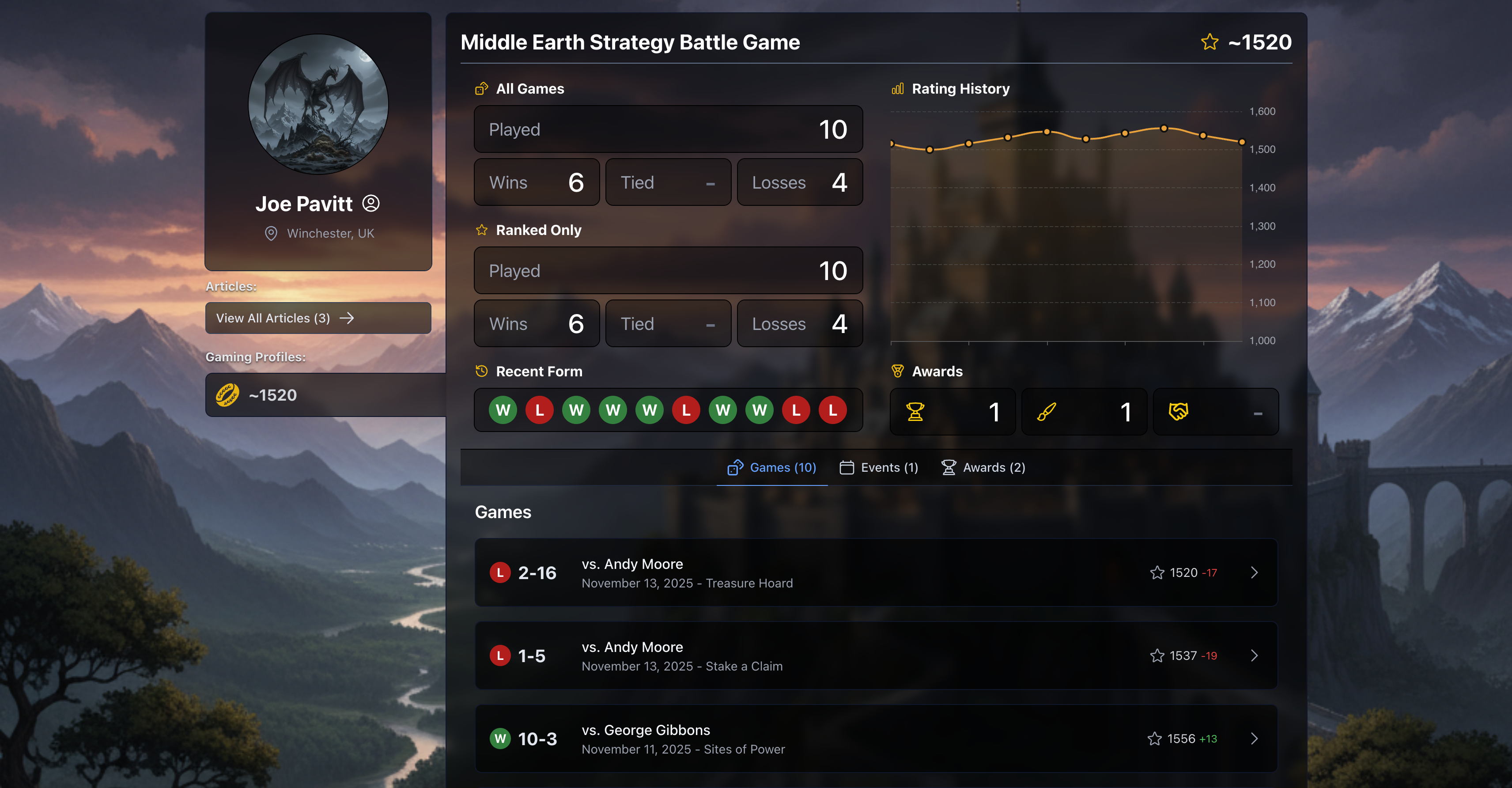
Not only that, but if you sign up to Siege Ladder you can also get your own Shape of War. Document your games here and get insight into your owns strengths and weaknesses. You can see mine for the 75 games I have logged on here on my Siege Ladder Profile.
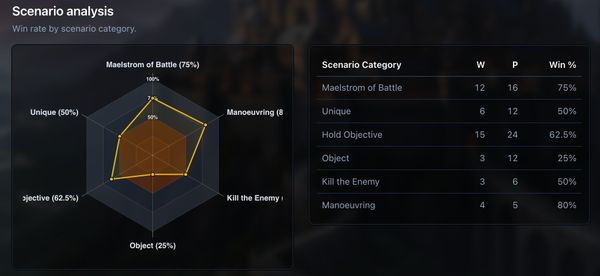
Whilst I do need to get more games under my belt for this to be more statistically significant, it definitely aligns to where I think I struggle myself - Object scenarios are just not for me. Especially Destroy the Supplies, which I've only ever managed one victory in so far.
Please let me know what you discover - what armies prove for interesting comparisons and where are you own strengths and weaknesses?